Prediction Market Regulations and Enforcement Demand House Scrutiny
Congress must address potential insider trading enabled by prediction markets and prompt the CFTC to strengthen its regulatory enforcement.
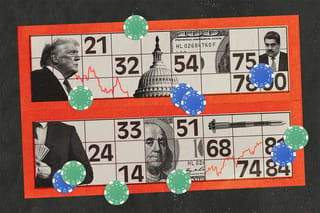
(Illustration: Luna Velez / POGO)
To:
- Representative Glenn “GT” Thompson
Chairman
House Committee on Agriculture
U.S. House of Representatives
Washington, DC 20515 - Representative Angie Craig
Ranking Member
House Committee on Agriculture
U.S. House of Representatives
Washington, DC 20515
Dear Chairman Thompson, Ranking Member Craig, and Members of the Committee:
Prediction markets have created increased opportunities for insider trading and corruption within all three branches of government. The rise in popularity of these prediction markets has outpaced the legal and regulatory structure that governs them. Since January 2026, there have been multiple high-profile, highly suspicious trades on prediction market platforms like Kalshi and Polymarket, but the Commodity Futures Trading Commission (CFTC) has failed to provide meaningful oversight or enforcement.
This gap between market growth and regulatory accountability leaves prediction markets vulnerable to exploitation by the entire government workforce, including federal officials, service members, and contractor employees.
The Project On Government Oversight (POGO) is a nonpartisan, independent watchdog that investigates, exposes, and champions reforms on systemic corruption, abuse of power, and waste. As such, we commend the Committee for its oversight of this matter and would like to raise several points and questions for its consideration.
Accountability and Enforcement Gaps
Currently, there are important gaps in accountability and enforcement that we hope this Committee will consider.
Despite expressly opposing insider trading, the CFTC has failed to apply meaningful scrutiny to contracts suspected of such. This is particularly true of prediction contracts related to political events and outcomes, military actions, and war. The CFTC has not demonstrated to the public and Congress that it is equipped to address the current pace of suspicious trades, which hurts the public’s trust in government. The government must do its due diligence to be above reproach and act in the interest of the public, not in the financial interest of those who are privy to material nonpublic information (MNPI).
Recent event contracts that generated high profits are against CFTC Rule 40.11.1 The CFTC holds discretionary authority to review and restrict contracts that refer or are related to “terrorism, assassination, war, gaming, or an activity that is unlawful under any State or Federal law.” Despite this rule, multiple accounts on Polymarket and Kalshi were able to secure hundreds of thousands of dollars by trading on event contracts related to the ousting of Venezuela’s president, Nicolás Maduro, and military actions in Iran.2 While Kalshi suspended certain event contracts that fall under CFTC 40.11, some were still permitted for live trade on these platforms.3
Improved monitoring and oversight are sorely necessary. The CFTC can review and restrict contracts that involve “terrorism, assassination, war, gaming, or an activity that is unlawful under any State or Federal law” or are “contrary to the public interest” under the Commodity Exchange Act.4 Yet contracts falling squarely within these categories are actively being traded. Large bets placed at long odds moments before major announcements or political events have raised serious concerns about insider trading and market manipulation.5 The CFTC must enforce stricter monitoring and accountability mechanisms on these platforms.
The Office of Government Ethics (OGE) must sound the alarm and provide guidance about the financial conflicts at issue. As the office that oversees ethics in the executive branch, OGE must highlight the criminal and civil laws that prevent financial trading on inside information. OGE should remind agency officials, inspectors general, and the Justice Department to enforce current ethics laws and policies, investigate any appearance of impropriety, and prosecute trades that solely enrich those who had inside information or possibly used that insider information to inform the decision to such trade.6
The CFTC needs to be an ally to the public, not to designated contract markets and special interests. The CFTC is supposed to be an independent regulatory agency that serves the people. If designated contract markets, including prediction market platforms, fall short in protecting the public interest and cause harm, the CFTC must make decisions that prioritize the public. Therefore, the CFTC needs to create opportunities for public stakeholders (not just private interests) to engage closely with the commission.
Questions for Consideration
- What steps is the CFTC taking to investigate suspected instances of insider trading on prediction market platforms?
- Does the CFTC have sufficient resources, authority, and expertise to monitor and respond to the pace and scale of potential insider trading on prediction market platforms?
- Is it possible that the irregular trading patterns observed on prediction market platforms involve the use of MNPI? What are the usual signifiers to identify the use of MNPI?
- What mechanisms does the CFTC have in place to investigate whether government personnel or officials are participating in trades that may constitute insider trading?
- Why does the CFTC’s Innovation Advisory Committee lack representation from public interest groups and what steps is the CFTC taking to ensure that consumer and civil society perspectives are included in its advisory processes?7
- How soon will the Office of Government Ethics provide warnings and trainings to agency ethics staff (and the entire government workforce) to prevent personal profiteering from insider information?
Prediction markets have no place in politics or government. While POGO recognizes the importance of market competition and innovation, these interests cannot come at the expense of public safety, health, and government integrity. POGO has recently published an analysis on prediction markets that includes potential legislative solutions, which we encourage you to review.8 For further inquiries, please contact me at [email protected].
Signed by:
- Janice Luong
Policy Associate